The Small Ritual That Marks the End of a Workday
A small ritual to end the workday can give a blurry day a clear stopping point, with simple options for home offices, shared spaces, and unfinished tasks.
What small ritual to end the workday would help you feel that work has stopped, even if the day did not feel complete? It might be closing a notebook, clearing one corner of a desk, or changing the light in a room. The useful ritual is not an impressive routine; it is a repeated action that gives the day a visible edge.
Work often ends by interruption rather than choice: a message arrives, a screen goes dark, or attention simply gives out. A small closing action can make that transition easier to notice. It does not erase unfinished tasks or promise calm. It marks a boundary you can recognize and return to.
Choose a ritual that fits the shape of your workday
Start with the moment your work usually loosens. If you work from a desk, the cue might be putting away a notebook. If you move between rooms or tasks, it might be returning a pen to the same cup or switching off a particular lamp. The action should be easy to repeat in the setting you actually use.
Think of the ritual as a bookmark, not a locked door. A bookmark marks where you stopped without pretending the story is finished. In the same way, closing your planner can mark a pause while leaving room to resume the task later.
Choose one small action rather than a sequence that requires perfect conditions. A ritual that depends on having a clear desk, an empty inbox, and a quiet room may fail on the days you most need a stopping point. A brief action with one familiar object is more adaptable.
Match the closing action to your situation
If you work at a dedicated desk
Putting away a notebook or placing your pen beside it can create a clear visual change. This fits when the desk remains available after work and you can leave the work materials in a settled state. If the desk is also used for meals or hobbies, choose an action that does not imply the whole surface must stay untouched.
If you work at a shared table
Use a portable cue: close the laptop, return papers to a folder, or place work items in a tote. This suits a space that must quickly become a kitchen, dining area, or family workspace. The point is not to make the room look perfect, but to put work into a recognizable resting place.
If your workday ends at different times
Anchor the ritual to an event rather than a fixed hour. You might close your notebook after sending the final message you intend to send, or put your headphones away when you leave the work area. This is useful for variable schedules because the cue follows the end of your work, not the clock.
If unfinished tasks keep pulling your attention back
Before closing your notebook, write one short line naming the next action. For instance, note “ask Mira for the revised draft” rather than writing “continue project.” This gives a future starting point without requiring you to solve the task now, and then the notebook can be closed.
If you share your home with others
Choose a cue that makes sense to the people around you, such as moving a work bag to a shelf or turning off a desk lamp. A visible action can help signal that you are no longer available for routine work questions. If your household needs a different arrangement, choose a cue that is practical for everyone who uses the space.
How do you make the ritual easy to repeat?
What should the ritual include?
Keep it to one or two actions with objects already in reach. Closing a planner and setting it beside your bag is enough; adding a long reflection or a full-room reset may make the ritual feel like another assignment.
Should the ritual happen at the same time every day?
Not necessarily. A consistent cue can be more useful than a consistent hour when schedules shift. Link the action to something observable, such as leaving the desk or finishing the task you chose for that day.
What if you forget to do it?
Let the next ordinary pause become the cue. You do not need to recreate a missed ritual or treat it as a failed day; simply close the notebook or put away the work items when you notice the transition.
Can the ritual make unfinished work feel resolved?
No. It can distinguish stopping from continuing, but it cannot make a task complete or remove every concern about it. A brief note about the next action can help contain the loose end without pretending it has disappeared.
Make the action concrete, not elaborate
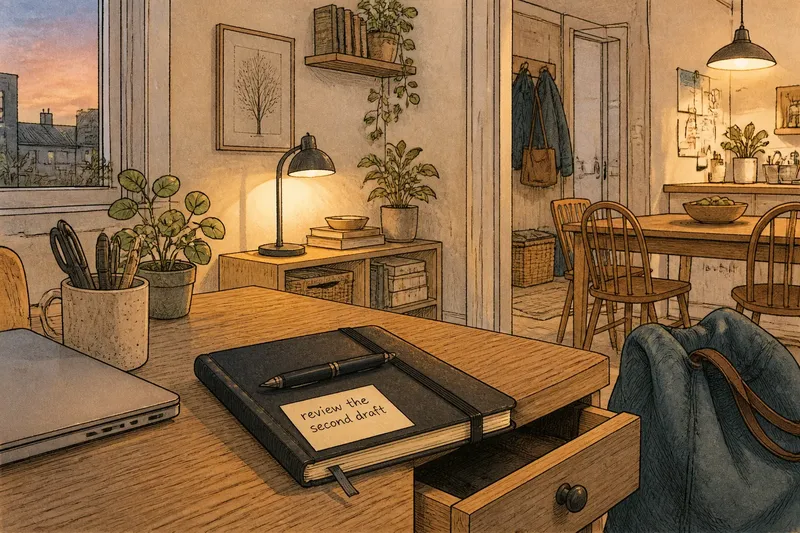
Say you finish the day at a kitchen table that must be cleared for dinner. You close your notebook, write “review the second draft” on tomorrow’s page, and place the notebook in a drawer. The expected observable result is modest: the work materials leave the table, and you have a clear place to begin later.
That action works because it joins a physical change to a useful reminder. You can adapt it by choosing another object that already belongs in your routine: a folder, a mug used for pens, a work bag, or a lamp. Avoid adding steps just because a ritual sounds more meaningful when it is longer.
If your work involves sensitive papers or shared devices, the closing action can also include putting materials where they belong. Follow the relevant workplace, manufacturer, or local instructions when handling information or equipment; the ritual itself should not replace those requirements.
Let the ritual mark a boundary without demanding a mood
A closing action does not have to make you feel peaceful, satisfied, or finished. Some days will still feel scattered. The useful change is that you have made a deliberate, recognizable move from work time into whatever comes next, rather than waiting for a perfect sense of completion.
Notice whether the cue is easy to remember and whether it fits the space you use. If it repeatedly gets in the way, simplify it or choose a different object. The small ritual to end the workday should make the stopping point easier to see, not turn the end of work into one more task to get right.
Keep the chosen object in its natural place so the cue is waiting when you need it: a notebook near the desk, a folder beside the work bag, or a lamp you can switch off as you leave. That small bit of preparation makes the boundary easier to repeat on an ordinary, unfinished day.