Before the Keepsake Box: How People Saved Small Reminders
How people saved small reminders varied by place and purpose; trace the keepsake's path from an ordinary token to a collection that holds a life story.
How people saved small reminders becomes easier to picture when you begin with an ordinary object: a folded note tucked into a book. Imagine a hypothetical household in which Mara finds such a note while sorting a drawer, then starts asking what else her family kept and why. The answers would not reveal one universal custom. They would show how particular objects gathered meaning through use, circumstance, and the stories attached to them.
A reminder begins as an object with another use
Before a keepsake is a keepsake, it is often something practical or incidental: a ticket, a ribbon, a button, a pressed leaf, or a scrap of handwriting. Its original purpose may be plain, while its later meaning comes from the person, place, or event associated with it.
That shift does not require a formal decision. A note might stay in a drawer because its recipient cannot quite throw it away. A small stone might return home in a coat pocket after a walk. In time, keeping becomes a quiet act of recognition: this item belongs to a moment I want to be able to recall.
The object works a little like a bookmark. It does not contain the whole book, but it helps someone return to a particular page. A keepsake can prompt a memory without preserving every detail of what happened.
How people saved small reminders depended on their surroundings
There was no single route from everyday token to personal collection. What a person could keep depended on what was available, what had room to be stored, and what mattered in that household or community. A ribbon, a religious token, a handwritten recipe, or a fragment of a familiar place might each carry significance in a different setting.
Small items were easy to slip into a pocket, tuck between pages, or place in a box. Paper could hold a message or record a date; a piece of cloth could recall clothing or an occasion; a coin or souvenir could stand for a journey. The same kind of object could mean little to one person and a great deal to another.
Some reminders were kept privately, while others were meant to be seen or passed along. A family might preserve letters together, or someone might keep a token close without explaining it. These practices can overlap, but they are not interchangeable: a displayed heirloom, a private note, and a child’s collection each have different audiences and purposes.
A drawer becomes a family collection
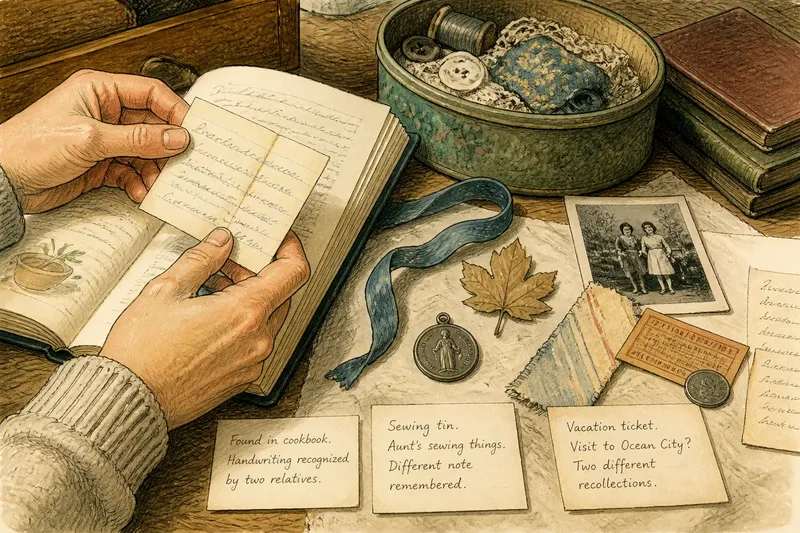
In the imagined household, Mara’s first find is a folded note in a cookbook. It carries no elaborate inscription, but a familiar phrase helps her connect it to her late aunt, who used to leave reminders beside recipes. Mara asks relatives whether they recognize the handwriting; one recalls the aunt’s habit, while another remembers a different note in a sewing tin.
Rather than assume every saved item belongs to the same story, Mara gathers the objects on a clear table and keeps them in their existing groups. The cookbook note stays with the book it came from, and the sewing tin remains separate. She writes a short description on slips of paper: where each item turned up, who recognized it, and what remains uncertain.
As the household talks, the loose finds begin to form a collection—not because Mara adds many objects, but because the items acquire relationships. A recipe note points to a repeated family habit; a scrap of fabric recalls a garment someone remembers; a ticket prompts two different recollections of a visit. The disagreements matter too. They show that a collection can preserve several accounts rather than settle on one official version.
Small reminders change as people gather them
Gathering objects changes what they can do. A lone ticket may call up one afternoon; placed beside a letter and a photograph, it can suggest a broader connection among people and places. The collection supplies context, but it also invites interpretation. A later reader may notice a link that the original keeper never intended.
This is one reason labels and accompanying stories matter. A bare object may be hard to identify after its keeper is gone, while a brief note can preserve useful context without pretending to explain everything. “Found in the cookbook; handwriting recognized by two relatives” is more careful than assigning an uncertain date or declaring who wrote it.
Collections also reflect choices. Someone decides what to keep, where to put it, and what to leave out. Those choices may follow affection, convenience, family custom, or the simple fact that an item survived a move. A collection is therefore not a complete record of a life. It is a set of surviving clues shaped by people and circumstance.
What can a saved object tell you?
Why did people keep ordinary objects?
An ordinary object could stay because it recalled a person, place, or occasion, or because its keeper found it useful. Its meaning might emerge gradually rather than through a deliberate act of collecting.
How is a keepsake different from a souvenir?
A souvenir is commonly acquired to mark a visit or experience, while a keepsake can be any retained object that comes to stand for a memory. The categories can overlap, but personal meaning—not the object’s original label—makes the distinction.
How can I record a keepsake’s story?
Note where it came from, who remembers it, and which details are uncertain. Keep the account brief and specific, so a future reader can distinguish what someone recalls from what the object itself establishes.
Should I keep every family reminder together?
Not necessarily. Keeping items in the groups or containers where they were found can preserve useful clues, while a written note can connect related pieces without physically combining them.
The meaning can outlast the original keeper
Back in the hypothetical household, Mara chooses a small folder for the written descriptions and leaves the objects in their separate places. Her relatives can add what they remember, including uncertainty, without turning a handful of reminders into a single polished family story. The result is modest: a note has become a doorway to several memories, and the objects remain available for someone else to interpret.
That is the lasting lesson in how people saved small reminders: keeping an object does not freeze a moment, but it can give memory somewhere to begin. If you come across a family token, record the details you can actually place and leave room for what no one knows. The space around an object’s story is part of its history, too.