The Perfect Memory Myth: Why a Story Changes in the Telling
The perfect memory myth can make a story feel unreliable. Learn to separate vivid details from uncertain wording and share what you remember honestly.
Did your brother really say, “Don’t tell Mom,” or have those words grown sharper each time you retell the story? The perfect memory myth suggests that a meaningful memory should remain fixed, like a recording you can replay word for word. In practice, details can shift as you remember and retell a scene, and honest uncertainty can make your account more trustworthy.
That does not make every detail equally uncertain or render memory useless. You can separate what feels clear from what you are piecing together, then choose a telling that fits your purpose. A direct scene, visible qualifiers, or a reflective account can each leave the right amount of room for what you do not know.
A memory can hold a clear moment and a fuzzy edge
Remembering is not like opening a recording and pressing play. Think of a recipe card with a smudged line: the readable ingredients remain useful even if one instruction has blurred. A memory may preserve the room, someone’s expression, or your own feeling while leaving the exact wording unsettled.
When you recall an event, you may draw on the scene as you remember it now, details you heard from other people, and later interpretations of what it meant. Those elements can blend into a fluent story even though they do not have the same basis. Noticing the difference helps you avoid treating a vivid detail as a verified one.
Retelling also involves choices. You might shorten a long pause, clarify a confusing exchange, or select a detail because it conveys what the moment means to you. Shaping a story is not automatically dishonest; the problem begins when an invented bridge or uncertain phrase is presented as something you know happened exactly that way.
Three ways to tell a memory leave different room for uncertainty
There is no single right style for every remembered moment. A family anecdote told over dinner may need a different level of qualification from a private page you hope to revisit. Consider what each approach makes easy and what you need to keep in view.
A direct scene suits memories with a few steady details
Tell the scene straightforwardly when its central action and setting feel clear. You might write that the kitchen was crowded, your aunt was trying to save the cake, and everyone laughed when the plate tipped. Keep the account close to what you can actually call to mind; do not add exact dialogue just because a scene feels bare without it.
This approach suits a short personal story whose purpose is to convey the moment, not provide a transcript. It is less suitable if the account depends on a disputed line or a precise sequence you cannot confidently recall. A phrase such as “I remember her saying something like” signals approximate wording without taking the reader out of the scene.
Visible uncertainty suits stories where a detail matters
Use a qualifier when an uncertain detail affects how a reader understands the event. Phrases such as “as I remember it,” “I think,” and “the words may have been” locate the uncertainty. They share what you recall without claiming precision you do not have.
This approach can suit a letter, family history, or story about a conversation whose wording carries weight. Too many qualifiers can make every sentence sound equally doubtful, so reserve them for details that need them and state firmer details plainly.
A reflective version suits a story whose meaning has shifted
Sometimes what matters is not only what happened but how your understanding changed. You can describe your earlier impression, then explain how you see the moment now. A childhood memory of a parent’s silence might once have seemed like anger; as an adult, you may interpret it differently while acknowledging that you cannot know exactly what your parent felt.
This approach suits memoir or a personal essay about changing perspective. It is not a reason to reshape the past until it supports a neat lesson. Keep the earlier and current interpretations distinct, and leave open what neither can settle.
Choose the telling that fits the detail and the reader
Start by asking what you most want to communicate. If it is the atmosphere or action, a direct scene may be enough. If a phrase, date, or sequence carries the meaning, consider how sure you are before making it central.
- If the central action feels clear: Tell the scene directly and use details you recall. If the action itself feels uncertain, describe the uncertainty rather than making the sequence definite.
- If the wording is uncertain: Paraphrase or mark the phrase as approximate. If you remember the exact words closely, quotation marks may fit.
- If an important sequence is hazy: State the order you remember without adding a firm transition. If the order is unclear, say so and focus on the parts you can place.
- If your perspective has changed: Separate what you thought then from what you think now. If the earlier view is also unclear, avoid presenting it as settled.
- If the story involves family members: Identify your account as your recollection. If another person remembers it differently, leave room for that difference rather than calling your version the shared record.
- If the story is for a private journal: Keep fragments or competing versions if they help you remember your uncertainty. If you want a polished account for someone else, retain a brief qualifier where it matters.
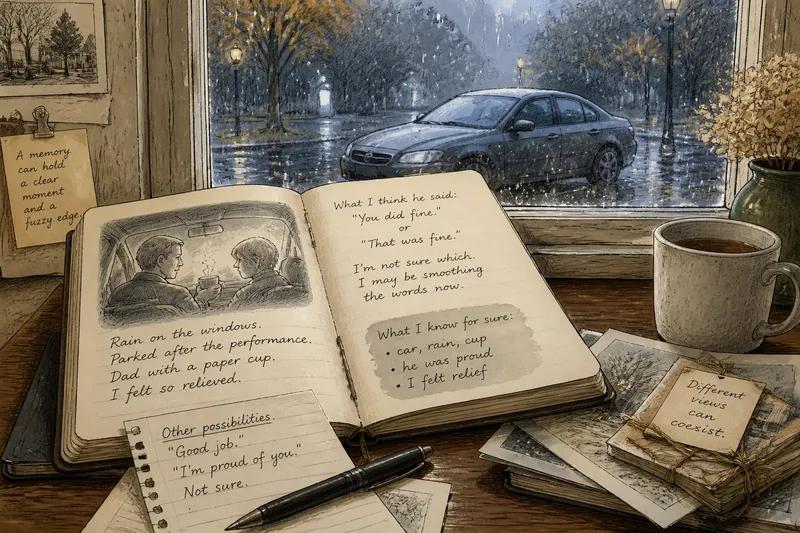
Imagine you recall sitting in a parked car after a school performance, rain on the windows and your father holding a paper cup. You remember feeling relieved, but cannot settle whether he said “You did fine” or “That was fine.” First, keep the details you recall clearly: the car, rain, cup, and your relief. Next, avoid presenting either phrase as exact dialogue; you could write, “I think he said I did fine, though I may be smoothing the words now.” The resulting story preserves its emotional center while showing the reader which wording remains uncertain.
A private journal can hold fragments, competing versions, or a note that a detail feels uncertain. A story shared with relatives may benefit from language that leaves room for their recollections rather than presenting your account as the family’s official record. If their version differs, you can still tell your own without settling the disagreement.
Small writing choices can keep an account honest
Should you put remembered dialogue in quotation marks?
Use quotation marks when you remember the wording closely enough to present it as speech, not simply because dialogue makes a scene lively. If you know the meaning but not the exact phrase, paraphrase it or say the words were something like what you recall. The distinction keeps the scene readable without disguising uncertainty.
What if another person remembers the scene differently?
Describe your own recollection as yours. Another person’s account may reflect a different perspective, a detail they noticed, or a difference neither of you can resolve. Do not fold their version into your story as confirmation unless you know that is what they intended.
How can you keep an uncertain memory from becoming more certain?
Mark the detail you are unsure about rather than filling the gap with the most satisfying version. If the distinction matters later, note separately what someone told you and what you remember yourself. A brief margin note can preserve that distinction without interrupting the story.
Does uncertainty make a personal story less meaningful?
No. A story can matter because of the feeling, relationship, or question it carries, even when some wording or sequence remains unclear. Naming that limit helps readers understand what you recall and what you are interpreting.
A story can be clear without being airtight
Polishing a memory can help a reader follow it, but polish need not mean certainty. Keep the details that carry the scene, qualify the parts that need it, and present interpretation as interpretation. When a memory changes in the telling, you can acknowledge that movement instead of pretending to have recovered a perfect version.
The perfect memory myth can feel especially persuasive when a story has become part of how you explain yourself or your family. An honest account does not have to settle every detail. When you write down your next memory, distinguish what you recall from what you are making sense of now; that small distinction can preserve both the story and its limits.