A Quiet Sunday Walk for Noticing Familiar Streets
A quiet Sunday walk for noticing familiar streets turns an ordinary route into a gentle practice of attention, with a focus that keeps it unhurried.
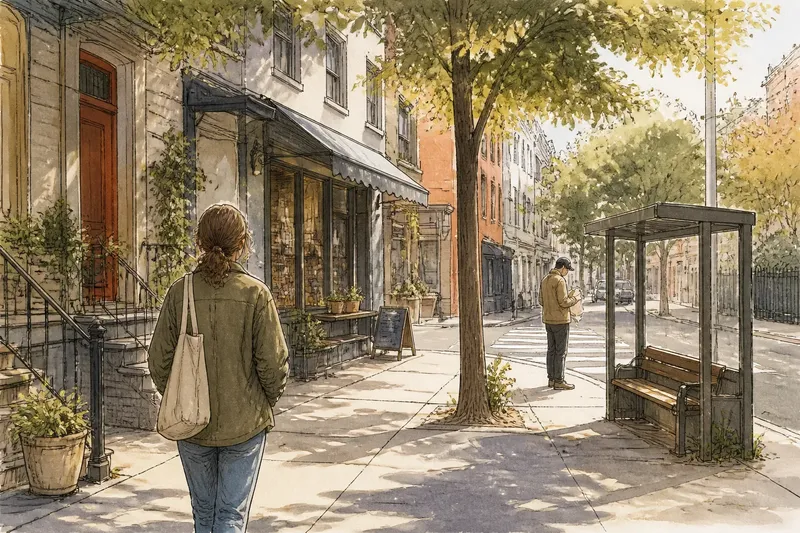
Which familiar street changes when you give it your full attention? A quiet Sunday walk for noticing familiar streets begins with a simple choice: revisit a route you already know, and carry one gentle question about what you might hear or see there. The purpose is not to collect discoveries or produce a polished story. It is to let an ordinary place feel particular again.
Choose a route with room to pause and an easy way home. Then settle on one observation, such as doorways, shifting sounds, or the edges between public and private space. That focus is a little like holding a paper frame around one corner of a picture: the rest remains present, but your eye has somewhere to rest.
Choose a route that leaves room to wander
Start with a street or small loop you can recall without a map. It might pass a corner store, a row of porches, a bus stop, or the block where you once waited for someone. Familiarity makes it easier to notice subtle details because you are not spending your attention on finding your way.
Keep the route modest enough that you can slow down without worrying about an appointment or a long return. Consider where you can turn around, sit briefly, or take a quieter side street if the main road feels busy. A route does not need to be scenic; a plain stretch with a few distinct surfaces, sounds, or entrances can offer plenty to notice.
If you are unsure where to go, think of a place you pass in routine life but rarely visit at an unhurried pace. Pick a starting point with a clear landmark, such as a library entrance or a familiar intersection. You can decide the rest as you walk, rather than planning a sequence of stops.
Give the walk one observation to follow
Choose a focus that invites attention without turning the walk into a hunt. “Notice thresholds” might draw your eye to stoops, gates, shop entrances, and the line where sidewalk meets driveway. “Notice sounds” could make room for a delivery cart, leaves brushing a fence, a distant ball game, or the quiet that follows a passing car.
Other useful focuses include light on building fronts, signs that have been repaired, benches and places to wait, or the way plants meet brick and pavement. Choose something broad enough to show up in different forms. If the focus is too narrow, you may begin scanning for a particular object and miss the feel of the street around it.
You do not need to announce the focus to yourself like a rule. Try wording it as a question: “Where does this block invite someone to pause?” or “Which sounds belong to this street today?” A question leaves room for an unexpected answer, while a target can make each passing detail feel like a score.
Begin at an ordinary pace
At the starting point, take a moment to notice the weather, the quality of light, and how the street sounds before you move. There is no need for a formal breathing exercise or a special mood. Simply give yourself enough time to arrive in the place instead of carrying the hurry of the day straight onto the sidewalk.
Walk at a pace that allows you to see peripheral details. Keep your phone put away if you do not need it for directions, and let the route remain familiar rather than tracking every turn. If you use a walking aid or need to stay alert to traffic, prioritize safe movement and choose observations that do not draw your attention away from your surroundings.
On a residential street, looking is enough; you do not need to enter yards, peer through windows, or photograph people. Notice what is available from the public path: a curtain moving in an open window, a planter beside a stoop, or a gate left ajar. Respect for other people’s privacy is part of paying attention to a place as it is shared.
Let details arrive without collecting them
As you walk, return to your observation now and then, but do not require every block to provide an answer. A doorway may remind you of a neighbor’s habit of leaving a package by the step; a patch of shade may bring back the feel of waiting for a late bus. Let the connection come and go without stopping to explain it to yourself.
Notice change alongside continuity. A new sign might hang where a familiar one used to be, while the worn stone at the corner remains. Neither needs to be treated as a discovery. The point is simply to see how the street holds both what you recognize and what has shifted since you last paid close attention.
Imagine you take a Sunday loop past the bakery where you once met a friend, with the question, “Where do people pause?” in mind. You notice a narrow ledge beside the shop entrance, a person checking a paper bag at the corner, and a patch of sun on the bus shelter bench. You keep walking rather than turning those details into a required list; later, the ledge might be the detail that helps you remember the feeling of that block.
If the focus starts to feel like work, loosen it. You can widen “thresholds” to include any place where the street changes character, or set the question aside and walk by the familiar shape of the route. A gentle practice should remain receptive, not become a test of whether you noticed enough.
What should you do when the route feels unchanged?
Can the same street offer anything new?
It can feel different because you are arriving under different conditions: the light, weather, nearby activity, or your own reason for walking may have changed. You do not need to find a dramatic difference; a familiar detail seen clearly can be enough.
What if nothing catches your attention?
Keep moving at an easy pace and return to the observation as a question, not a demand. If it still feels forced, let the street itself set the subject, such as its quiet, its interruptions, or the way one block leads into another.
Should you take notes during the walk?
You can, but you do not have to interrupt the walk to record every thought. If a phrase seems likely to slip away, pause somewhere safe and jot down a few words in a pocket notebook or phone; avoid writing while crossing streets or moving through crowded areas.
How do you choose a different focus next time?
Use what you remember from this walk to choose a fresh question rather than building a sequence you must complete. If you followed sounds today, you might notice how people use the edges of a block next time, or simply return to the same question in another season.
Bring back one detail, not a report
When you reach your starting point or decide to turn home, allow the walk to end without a verdict. You might pause to name one detail that stayed with you, such as a gate clicking shut or a row of small signs above a shopfront. If nothing stands out, the walk can still have been worthwhile; attention does not always produce a memorable image on demand.
If you want to keep a trace, write a few unpolished words after the walk. Include the place, the observation you carried, and one sensory detail or small association. For example: “Maple corner, thresholds: blue door set back from the sidewalk; heard a broom on the bakery step.” A brief note gives your memory a point of return without turning the walk into a report.
You can also leave the detail unrecorded. The useful part may be the way you now recognize the small ledge beside the shop or hear the bus shelter differently when you pass it during the week. A quiet Sunday walk for noticing familiar streets works best when its focus remains an invitation: one attentive route, one open question, and enough space for the place to answer in its own way.